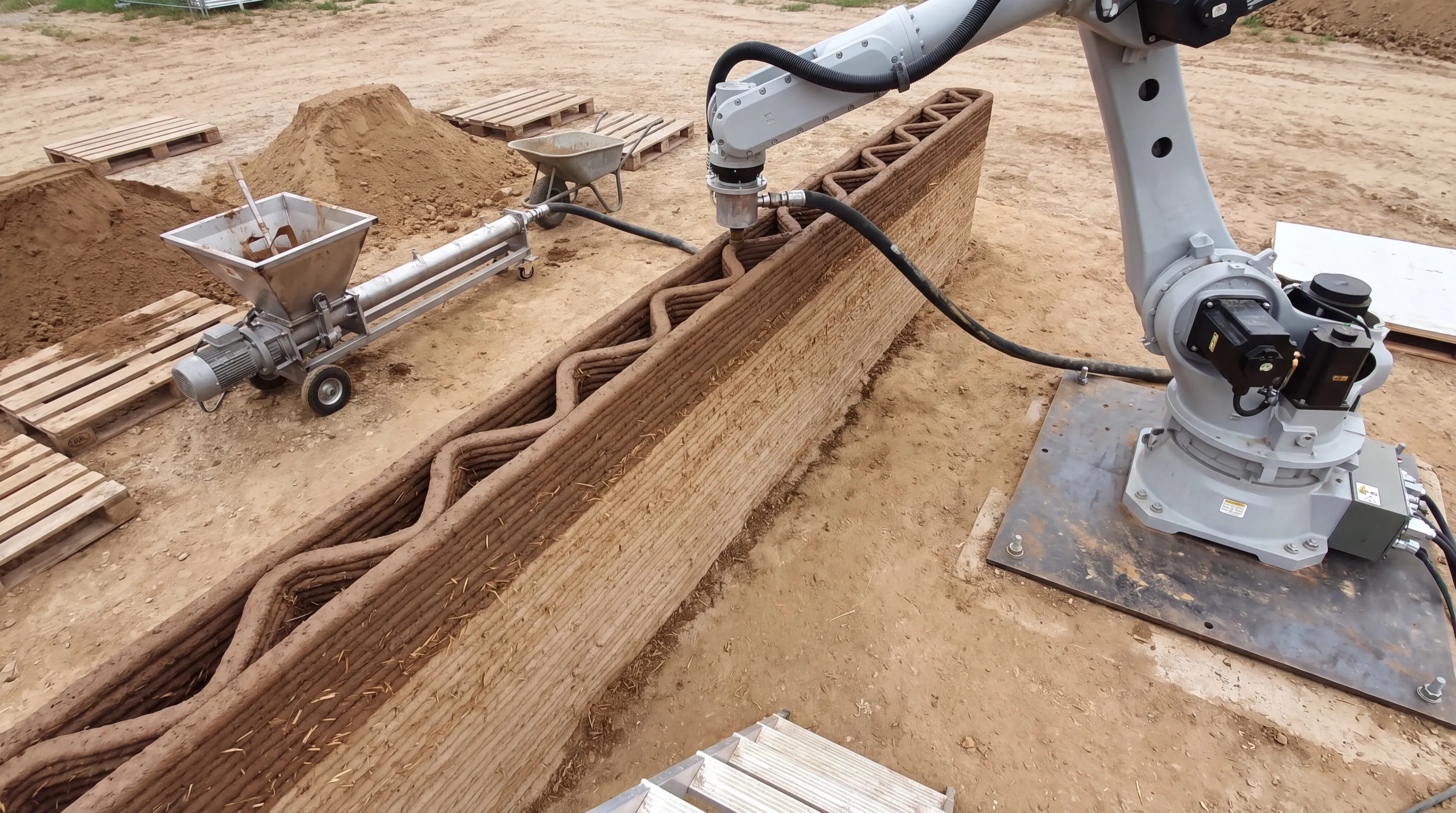
The EARTH3D Best Practice Guide features 19 projects in 3D printing with raw earth. Each one is introduced here in a short video.
The videos play from Vimeo. Nothing is loaded from Vimeo until you press play, and the player does not track you. Subtitles: English, Polish, Portuguese, Estonian, Dutch.
Fluid-2-Clay
Project 01, Netherlands, 2025
Fluid-2-Clay, by Vertico and EKWC, prints with liquid clay.
Transcript and details
Narration
Fluid-2-Clay, by Vertico and EKWC, prints with liquid clay. A robot pumps a clay slurry, which mixes with electrolytes at the nozzle. It turns into a stable gel the instant it is deposited. More in the EARTH3D Best Practice Guide.
Place and year
Netherlands, 2025
Technology
Type V (Robotic), Pump (Ion-Active)
Material
Class A (Unfired clay)
Geometry
3D (Voronoid)
Highlight on screen
Liquid clay becomes a stable gel the instant it is deposited.
Images
Photo: Vertico
ESA Mars Habitat
Project 02, Netherlands, 2024
Vertico and TU Delft printed with Martian soil for ESA.
Transcript and details
Narration
Vertico and TU Delft printed with Martian soil for ESA. Fine, sticky particles keep the mix pumpable with the right water dose. Simulated Martian soil replaced 70% of the printing mix. More in the EARTH3D Best Practice Guide.
Place and year
Netherlands, 2024
Technology
Type V (Robotic), Pump + Screw
Material
Class B (Regolith)
Geometry
3D (Voronoid)
Highlight on screen
70% of the printing mix replaced with Martian soil simulant.
Images
Photo: Vertico
InnovA58 Acoustic Barrier
Project 03, Netherlands, 2024
InnovA58, commissioned by ProRail, is an acoustic barrier printed on site.
Transcript and details
Narration
InnovA58, commissioned by ProRail, is an acoustic barrier printed on site. Earth, gravel and plant fibres are shot into place, without formwork or cement. The result: 90% less CO2 than concrete barriers. More in the EARTH3D Best Practice Guide.
Place and year
Netherlands, 2024
Technology
Type V (Robotic), Jetting (Shot-Earth)
Material
Class B (Stabilized)
Geometry
3D (Wall)
Highlight on screen
90% lower CO₂ emissions than conventional concrete barriers.
Images
Photo: Terrestrial; Visualisation: Terrestrial
Hope Village Center
Project 04, Tanzania, 2025
Hassell's Hope Village building in Tanzania is designed with printed clay walls.
Transcript and details
Narration
Hassell's Hope Village building in Tanzania is designed with printed clay walls. Their open pattern admits light and air, for passive climate control. The clay comes from within 25 miles of the site. More in the EARTH3D Best Practice Guide.
Place and year
Tanzania, 2025
Technology
Type IV (SCARA), Pump + Screw
Material
Class A (Local Earth)
Geometry
3D (Hub)
Highlight on screen
Clay sourced within a 25-mile radius of the site.
Images
Visualisation: IMIGO for Hassell; Photo: IAAC 3dPA
Lib Earth House Model B
Project 05, Japan, 2025
Lib Work's Lib Earth House combines printed earth with a timber frame.
Transcript and details
Narration
Lib Work's Lib Earth House combines printed earth with a timber frame. The printed shell forms the envelope; timber carries the loads. Its mix of soil, lime and plant fibres has no cement. More in the EARTH3D Best Practice Guide.
Place and year
Japan, 2025
Technology
Type IV (SCARA), Pump + Screw
Material
Class B (Earth + Lime)
Geometry
2.5D (Planar)
Highlight on screen
Soil, lime and plant fibres, without cement.
Images
Photo: Lib Work
To Grow a Building
Project 06, Italy, 2025
To Grow a Building, for the Venice Biennale, explores living architecture.
Transcript and details
Narration
To Grow a Building, for the Venice Biennale, explores living architecture. It is printed from local soil, with seeds from 14 plant species. As they grow, their roots bind the structure. More in the EARTH3D Best Practice Guide.
Place and year
Italy, 2025
Technology
Type IV (SCARA), Pump + Screw
Material
Class A (Living Soil)
Geometry
Non-Planar
Highlight on screen
Seeds from 14 plant species grow through the printed soil.
Images
Photo: WASP
Intrusion Earth AM
Project 07, Germany, 2024
TU Munich's Intrusion Earth AM pairs earth printing with a particle bed.
Transcript and details
Narration
TU Munich's Intrusion Earth AM pairs earth printing with a particle bed. A robot prints earth paste, adds recycled brick, then compacts both. Less mixing water means less shrinkage and shorter drying. More in the EARTH3D Best Practice Guide.
Place and year
Germany, 2024
Technology
Type V (Robotic), Batch (Intrusion)
Material
Class A (Earth Paste)
Geometry
3D (Volumetric)
Highlight on screen
Compaction instead of flow: less water, less shrinkage, shorter drying.
Images
Photo: Ema Krakovská, TU Munich; Video still: AMC TRR 277, TU Munich
Living Soil Wall
Project 08, USA, 2022
University of Virginia researchers print soil structures that grow plants.
Transcript and details
Narration
University of Virginia researchers print soil structures that grow plants. Seeds go into the soil ink or between layers, and both prototypes sprouted. Failed prints can be remixed and printed again. More in the EARTH3D Best Practice Guide.
Place and year
USA, 2022
Technology
Type V (Robotic), Pump (Paste)
Material
Class A (Soil + Seeds)
Geometry
3D (Vessel)
Highlight on screen
Failed prints can be broken down, remixed and printed again.
Images
Photo: University of Virginia
TOVA
Project 09, Spain, 2022
TOVA, by IAAC with WASP, is Spain's first 3D-printed building.
Transcript and details
Narration
TOVA, by IAAC with WASP, is Spain's first 3D-printed building. It was printed from local soil, stabilised with cellulose and aloe. At the end of its life, it can return to the soil. More in the EARTH3D Best Practice Guide.
Place and year
Spain, 2022
Technology
Type IV (SCARA), Pump + Screw
Material
Class A (Earth + Aloe)
Geometry
3D (House)
Highlight on screen
At the end of its life, it can be returned to the soil.
Images
Photo: Gregori Civera
Skylos
Project 10, USA, 2022
Skylos, by Emerging Objects, explores earth shelters printed on remote sites.
Transcript and details
Narration
Skylos, by Emerging Objects, explores earth shelters printed on remote sites. A lightweight robot prints adobe of local mud, silt and straw. Wavy corrugations give the thin shells their stiffness. More in the EARTH3D Best Practice Guide.
Place and year
USA, 2022
Technology
Type IV (SCARA), Pump + Screw
Material
Class A (Adobe)
Geometry
3D (Shell)
Highlight on screen
Sinusoidal corrugations stiffen the thin earth shells.
Images
Photo: Emerging Objects
Urban Reef Bio-Composites
Project 11, Netherlands, 2022
Urban Reef prints microhabitats that help cities support more forms of life.
Transcript and details
Narration
Urban Reef prints microhabitats that help cities support more forms of life. A Delta WASP prints porous forms of clay, mycelium and seeds. They hold water and shelter plants, fungi and microorganisms. More in the EARTH3D Best Practice Guide.
Place and year
Netherlands, 2022
Technology
Type III (Delta), Continuous (Screw)
Material
Class A (Raw / Bio)
Geometry
3D (Complex)
Highlight on screen
Printed microhabitats for plants, fungi and microorganisms.
Images
Photo: Urban Reef
TECLA
Project 12, Italy, 2021
TECLA is a printed earth habitat by WASP and Mario Cucinella Architects.
Transcript and details
Narration
TECLA is a printed earth habitat by WASP and Mario Cucinella Architects. A double dome forms structure, roof and envelope at once. It was the first habitat printed by several printers at once. More in the EARTH3D Best Practice Guide.
Place and year
Italy, 2021
Technology
Type III (Delta), Pump + Screw
Material
Class B (Earth + Lime)
Geometry
3D (Dome)
Highlight on screen
The first fully 3D-printed habitat built by several printers at once.
Images
Photo: WASP
Muddy Robots
Project 13, USA, 2023-2024
Muddy Robots, by Ronald Rael, uses robotic printing to revive earth building.
Transcript and details
Narration
Muddy Robots, by Ronald Rael, uses robotic printing to revive earth building. Mobile systems print adobe on site, even on difficult terrain. This includes the world's first on-site printed mud roof. More in the EARTH3D Best Practice Guide.
Place and year
USA, 2023-2024
Technology
Type V (Robotic), Pump + Screw
Material
Class A (Adobe)
Geometry
3D (Dome)
Highlight on screen
The world's first on-site 3D-printed mud roof.
Images
Photo: Muddy Robots
Casa Covida
Project 14, USA, 2020
Casa Covida, by Emerging Objects, rethinks the home for collective living.
Transcript and details
Narration
Casa Covida, by Emerging Objects, rethinks the home for collective living. A portable robot printed three linked units for sleeping, bathing and gathering. Built of adobe and straw, it is fully biodegradable. More in the EARTH3D Best Practice Guide.
Place and year
USA, 2020
Technology
Type IV (SCARA), Pump + Screw
Material
Class A (Adobe / Straw)
Geometry
3D (Coiled)
Highlight on screen
Adobe and straw, fully biodegradable.
Images
Photo: Elliot Ross and Emerging Objects
Terramia
Project 15, Italy, 2019
Terramia, by MuDD Architects, tests fast earth shelters for emergencies.
Transcript and details
Narration
Terramia, by MuDD Architects, tests fast earth shelters for emergencies. Three earthen shells are formed on bent bamboo and jute fabric. Drones spray it with clay, sand and rice husks. More in the EARTH3D Best Practice Guide.
Place and year
Italy, 2019
Technology
Type V (Drone), Jetting (Spray)
Material
Class A (Mud / Bamboo)
Geometry
3D (Shell)
Highlight on screen
Drones spray clay, sand and rice husks onto the formwork.
Images
Photo: Studio NAARO
Wall with Staircase
Project 16, Italy, 2019
WASP and IAAC printed an earth wall with a built-in staircase.
Transcript and details
Narration
WASP and IAAC printed an earth wall with a built-in staircase. Clay and rice fibre were printed in about 40 hours. Wooden steps are anchored into it without fasteners. More in the EARTH3D Best Practice Guide.
Place and year
Italy, 2019
Technology
Type III (Delta), Pump + Screw
Material
Class A (Earth)
Geometry
3D (Stair)
Highlight on screen
Wooden steps anchored into the printed wall, without fasteners.
Images
Photo: WASP & IAAC
Hearth (Mud Frontiers)
Project 17, USA, 2019
Hearth, part of Emerging Objects' Mud Frontiers, reimagines traditional earth building.
Transcript and details
Narration
Hearth, part of Emerging Objects' Mud Frontiers, reimagines traditional earth building. A portable robot printed local soil on site. It draws on Ancestral Pueblo and Indo-Hispano earth and pottery traditions. More in the EARTH3D Best Practice Guide.
Place and year
USA, 2019
Technology
Type IV (SCARA), Pump + Screw
Material
Class A (Adobe / Wood)
Geometry
2.5D (Wall)
Highlight on screen
Inspired by Ancestral Pueblo and Indo-Hispano earth traditions.
Images
Photo: Rael San Fratello
Clay Rotunda
Project 18A, Switzerland, 2021
ETH Zurich's Clay Rotunda is the soundproof shell of a music lab.
Transcript and details
Narration
ETH Zurich's Clay Rotunda is the soundproof shell of a music lab. A mobile robot placed over 30,000 soft clay bricks. Its wavy form, not reinforcement, keeps the thin wall standing. More in the EARTH3D Best Practice Guide.
Place and year
Switzerland, 2021
Technology
Type V (Robotic), Batch (Place)
Material
Class A (Unfired Clay)
Geometry
3D (Cylinder)
Highlight on screen
An undulating wall only 15 cm thick, with no reinforcement.
Images
Photo: Gramazio Kohler Research, ETH Zurich
Impact Printed Earth
Project 18B, Switzerland, 2024
ETH Zurich's Impact Printed Earth shoots earth instead of extruding it.
Transcript and details
Narration
ETH Zurich's Impact Printed Earth shoots earth instead of extruding it. A robot projects pellets at up to 10 metres per second, and impact binds them. The stiff mix is 75% excavation waste. More in the EARTH3D Best Practice Guide.
Place and year
Switzerland, 2024
Technology
Type V (Robotic), Jetting (Shooting)
Material
Class A (Excavated)
Geometry
Non-Planar
Highlight on screen
A stiff mix of 75% excavation waste.
Images
Photo: Michael Lyrenmann / Gramazio Kohler Research / ETH Zurich