Results
The Best Practice Guide is out in five languages
Nineteen 3D printed earth projects from around the world, analysed by material, technology and design, free to download in English, Polish, Portuguese, Estonian and Dutch.
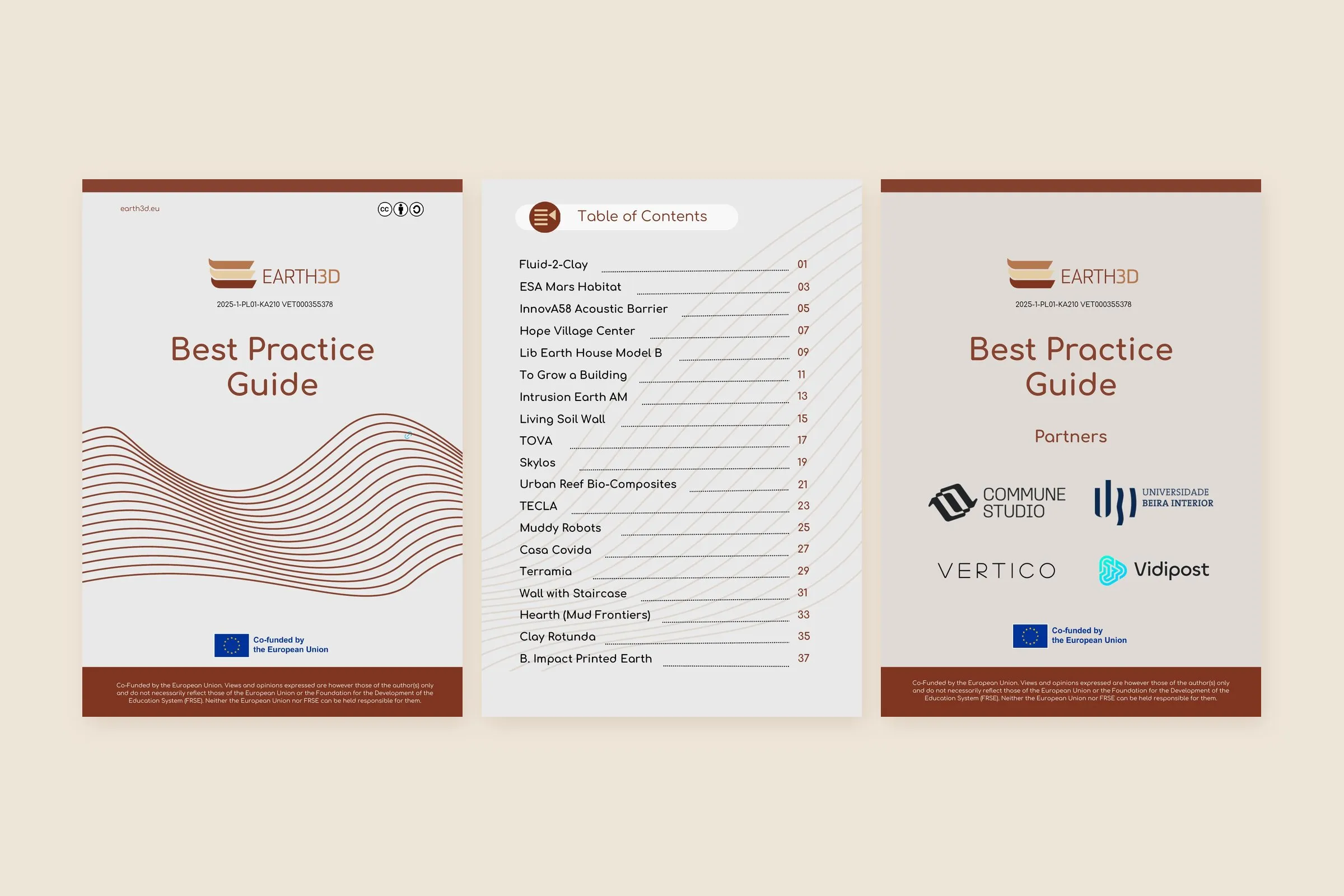
The EARTH3D Best Practice Guide, the first major result of the project, is now available. It brings together 19 projects in 3D printed earth from Europe, Africa, Asia and North America, documented in the same format so that readers can compare them on equal terms.
Inside each profile
Every project has a short profile: its partners and country, its category (Accessibility, Applicability or Aspiration), the printing technology, the material class and the geometry, followed by a text on what makes the project worth studying.
A few examples
- InnovA58 acoustic barrier (the Netherlands): a mobile robot prints a noise barrier of earth, gravel and bio-fibres along a motorway, projecting the material instead of extruding it. The project reports a 90% reduction in CO₂ emissions compared with conventional concrete barriers.
- Mars habitat study (the Netherlands): Vertico and TU Delft replaced 70% of a printing mix with simulated Martian soil while keeping the binder below 8%, a lesson in how local soils can be used on Earth too.
- Fluid-2-Clay (the Netherlands): liquid clay that turns into a stable gel as it leaves the nozzle, shaped by chemistry instead of force or firing.
- Hope Village Center (Tanzania), TECLA (Italy), TOVA (Spain) and more.
Download
The guide is free to use in teaching, training and professional practice. Download it in your language from the Project Results page.